 alt Hacker News
No signs of AI payoff outside the tech sector
Comments
"Tech" has been using LLMs since inception. Let's say 2022 for ChatGPT. Bank of America only just four years later, in October of 2026, managed to get some sort of AI (Copilot) to their employees to use. It's not showing up because it hasn't happened yet.
This is like saying that the internet hasn’t created positive value for all but the biggest firms in 1998. Give it a second.
Small sample size, but I've heard from multiple physicians that AI note taking allows them to see more patients or spend more time with them and they're very happy with those kinds of capabilities that take over toil
I doubt Excel'ification happens this fast. To make it "payoff" it needs to become the next Excel-levels of usage.
I have to wonder in this: how much of the revenue per worker boost in tech due to massive layoffs and coasting on momentum? Most tech workers I know do not describe a sustainable new environment with AI, but rather over-worked skeleton teams
„In SNP500 outside of tech”. This says little about general economy - and small companies are way faster in benefitting from CC.
Also, it’s been just 9 months of modern claude code, and for many companies less than 6 months since first employees outside of IT got access to Claude Code. What do they expect?
Many will fall for the road to be paved. This is the most advanced discovery for humans to date. There is no doubt it will succeed and is here to stay. It is still new (gold rush) and deregulated. A mine field for govs and businesses. We may see to big to fail crashing (.com bubble style or worse) but no one will ever stop AI.
Plumbers, electricians, car mechanics ... are probably making good money fixing messes that people got themselves into by following AI.
I think honestly, tech really doesn't help the core business case in a lot of instances. Imagine the local restaurant scene. Would sales really decline if you couldn't order takeout on grubhub? I suspect if a switch were flipped and there was no grub hub et al, sales would be the exact same. Demand for takeout has nothing to do with the manner it is ordered; you are hungry and don't want to cook and that's it. It's a ten thousand year old industry just from that.
Businesses end up buying into all these services because thats just what is done. It's keeping up with the joneses. It isn't clear that they really lead to more sales revenue and improved bottom line. Even taking on orders using the system doesn't imply that; your customers might have just been shunted through a different ordering system instead.
And that is with an actual tangible service being offered. What does AI offer a restaurant? Outside code gen it's basically fancy google. What are they going to do, prompt it 'how can I make more money'? That would probably offer the same utility as just searching the internet on similar keywords relevant to your small business. Not really a value add that isn't there.
“Tech sector is the first to adopt new tech” isn’t a groundbreaking revelation. I’m sure you could make similar charts for the computer, the internet and all other similar innovations.
This is a pretty pathetic analysis especially for an analysis from a firm like Apollo. A few notes:
1. Profit margins from the mag 7 are on an upward trend starting in 2020. This is pretty consistent with the insane topline growth had by covid and the most recent layoffs occurring over the last 6 years. To unilaterally attribute this to AI implementation is lazy.
2. Most non-tech firms are only implementing AI just now because we finally have better enterprise tooling required. We won't see the effects for another 12-24 months at least.
3. As a former management consultant, this might be the worst use of a stacked bar chart I've ever seen: https://www.apollo.com/content/dam/apolloaem/images/daily-sp...
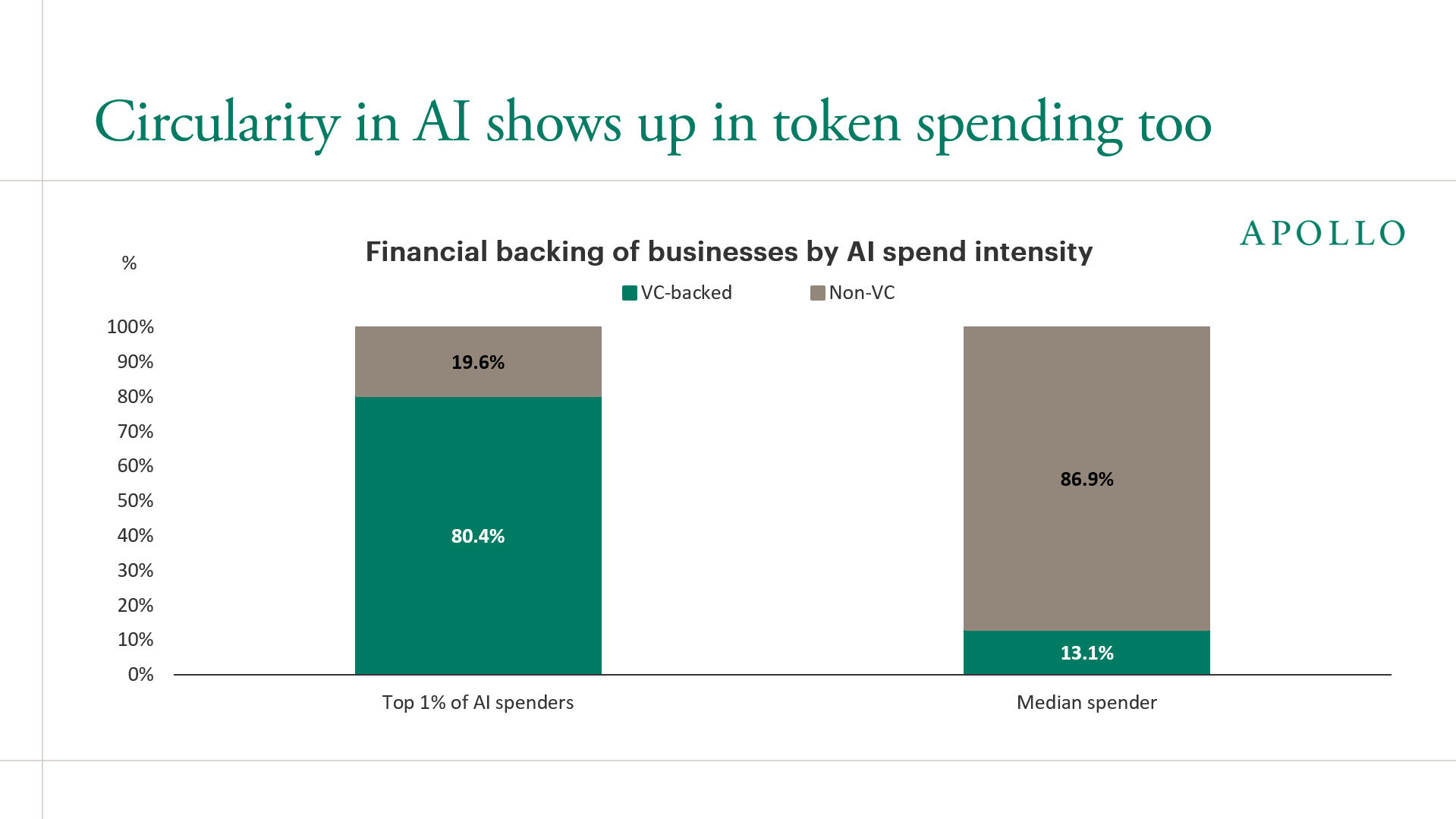
4. I don't know how you actually isolate AI productivity gains on a macro level. It seems pretty much impossible.
This whole thing is laughable.
The first giant web market collapse was because no-one could work out how to make money from it or do anything more useful than put the company brochure online.
no signs of mega tsunami damage outside of the shore - "News reporter says in the 50km radius shadow of a tsunami large enough to block out the sun"
The best training comes from LLM users. Loads in software to train on.
Not so much in accounting, which is a much easier problem.
Software devs eagerly trained their replacement.
Well, writers can use it to speed up the draft review process. Not a big financial deal, but it's a 'payoff' for the craft.
My sector used it to make all the tools we wanted, then put it back in its box awhile ago. Just enjoying the fruits rent free.
Tell that to legal firms and patent guys
Ye, it was easiest to steal all of stackoverflow and sell it back to you.
Pretty much the same thing inside tech, I love AI for my personal projects but the productivity return in my dayjob has been slightly negative so far.
Payoff doesn’t matter. The future potential (payoff) is what matters.
"Productivity growth" just means same revenue for fewer employees. It would be ironic if that were the measure. (And no one argues that every business would benefit as expected when using the entire index as a signal.)
AI in medicine has become pervasive, resulting in less time spent fighting IT or staying up-to-date and more time with patients; no one need be fired because you can always do better work.
It's the opposite of enshittification: quality has gotten better without any visible economic difference.
“Despite massive investments and widespread hype around [THE INTERNET], the technology has delivered zero financial payoff to corporate America outside of [THE PORN INDUSTRY]”
(1998 version of the story)
You won't get magical productivity gains from a workforce heavily conditioned to following orders and a pre-packaged process (the Henry Ford model and its various bastardizations). In order to extract value from an LLM, you have to be able to think and ideate so that the inputs are of higher quality.
It should be of zero surprise that the rush into AI has yielded limited results (if we're honest, both in and outside of tech)—you won't get a bunch of artists or creative thinkers out of a pliant, ironically agentic labor force. That's why most people say "it doesn't work": it's because they lack the skills and knowledge to use it properly (but corporations want to delude themselves into thinking they have a genie in a lamp).
Just a thought, but I kind of think this undersells just how important technology is or eventually becomes in almost every other economic sector.
The economics need to be rethought. What even is capital anymore? A ledger entry, compute, a license, IP? We are getting returns on what, setting the initial conditions?
All that’s left is offence surveillance logistics and insurance for a breakaway civilization.
The problem with profit in the tech sector is that they reduced payroll to boost the stock and enrich the single CEO.
They don't have the people. That is why all the big players keep using financing nonsense to buy everyone up. Killing competition is all the monopolists have left.
I think this is misreading the data.
We are functionally in a recession. The only way this isn't true is because of AI investment [1]. Additionally, GDP itself is flawed because it is propped up by housing, specifically imputed rent [2]. Another ticking time bomb is the $4T private equity backlog [3].
The real product of AI of labor displacement and wage suppression.
So while this article sees profits flat outside of the Mag 7, it should really be in decline to being flat is actually an improvement (IMHO).
We're not producing anything anymore. All we're doing is driving up revenues on inelastic demand on things like food, housing, electricity and health care. That's all PE is. And that's all our economy does now.
I really think people are underestimating just how close to breaking point our society is.
[1]: https://uhero.hawaii.edu/would-we-be-in-a-recession-without-...
[2]: https://www.taxresearch.org.uk/Blog/2023/02/14/10-or-gdp-is-...
> AI does not understand accountability, trust, culture, unwritten rules, ethical trade-offs or fairness, all of which shape reputational risk and ultimately drive revenue growth and profit margins.
This reminds me of the book The Redemption of Time. An alien society incapable of lying has no other way to understand deception than to study an actual human mind. The different ways that we are capable of thinking can be so hard to capture in an artificial system.
It's too early. There was a time where economist could not find productivity gains from PC products. I think I remember reading about it in the early 2000s over a decade after computers were common in business. Part of it is that companies aren't quick to throw what's work for tech that hasn't fully proven itself.
AI productivity gains are coming make no mistake about it. My guess is that we'll see them within the next 5 years.
It's almost as if profit isn't directly related to your jira board.
I would expect new disruptors to eat the lunch of the old, but that's slow.
Related:
Only 13% of companies see real returns from AI, survey finds - https://news.ycombinator.com/item?id=50207881 - October 2026
That's becuase eventually tech is going to eat the world. Everything will be augmented or replaced. Farming, construction, transportation, health, war, labor, all of it will change. So it has to start in tech and then it spreads from there.
For AI to be properly integrated into businesses it would need to be enabled by people who would shortly after become irrelevant.
This may well remain a "true communism/socialism has never been tried" situation.
ctrl+f: rsi, recursive self improvement - 0 hits. Really?
AI labs are focusing on automating and accelerating AI research, because that will accelerate AI development in other fields. Claims that non-tech topics are harder to train for are wildly over stated in this thread. Labs are focused on beating each other to RSI, and training on tasks that do not support that are a lost opportunity cost.
The entire economy will become part of the tech sector so this is kind of self-defeating.
Payoffs will come, but most likely it will be when new companies start up from scratch in other industries, not from current incumbents somehow adapting quickly to advances in AI. Give it a generation, and all will be transformed by then.
There is two ways of looking at this - one is that things are overhyped.
The other is that there is so much more value to be extracted before this bubble burst.
Not sure which I believe, objectively. Subjectively, inside of tech, it certainly feels like the former.
The car dealership I bought a vehicle from is using AI for all appointments, and it is quite highly functional, voice operated.
Suggest Apollo is not doing a good job of measuring improvements since these are soft costs and harder to measure. But, instead of saying that, they are just repeating a low IQ take.
Let's be clear: there are no signs of payoff within the tech sector, either. The supposed productivity gains are minimal to non-existent, unless you completely give up on quality. And that's the best case, the one they've put the most effort into! LLMs do not deliver what they promise, it is very clear based on real world experience.
Which is to be expected. Anyone who makes a tool without targeting specific use cases is really just making it for themselves.
What's embarrassing is how many people are clueless about where AI is going. The tech sector is one giant echo chamber, so it thinks whatever it makes will be a miracle cure. Everyone outside the echo chamber has no idea what it is/how it works, so they're just hoping it's the miracle cure the echo chamber keeps saying it is.
In reality, AI is just a minor improvement in productivity that doesn't solve hard problems. It does what we could already do before, a little faster & cheaper, without determinism/trust. It's a bigger, faster truck, but somebody still has to drive it, find a place to park it, spend more on gas, etc. It may be able to "think", but it won't replace humans until it can accept liability.
> the technology has delivered zero financial payoff to corporate America outside of tech.
I wonder if the argument cannot be made that it has delivered little payoff in tech as well - in terms of actual stable revenue vis-a-vis the immense capital investments, the deep loans, the circular commitments etc.
Those with the payoff might not be sharing.
Or inside for that matter
the amount of copium here, things are slow to move we get it, but thinking that AI is not going to disrupt everything is... some next level denial
“Internet may be just a passing fad as millions give up on it”
I've been doing workflow automations for many organizations for the last two years, and here is what I see:
1. every business unit and department was neglecting a best practice due to lack of investment in their organization. it has always been that way for decades and always will be that way because it isn't economically viable for it to be any other way. the workflow automations and agents we create act as digital workers that either do that neglected part, or let the rest of the organization do that neglected part.
2. the whole company always starts the year off with a bunch of goals, and by Q3 most of them are cancelled. now less of them are cancelled.
both factors mean that anyone just looking at "worker productivity" or "did we save money" is going to get the answer of no. everything is costing you the same, or the AI itself is costing you more. whatever contract I'm working under is definitely going to cost you more, if you don't cancel all those enterprise SaaS seats we told you to cancel.
I see a path to savings, but I don't think that's necessarily the metric to focus on. you need to look at the whole corporate structure, why are you still doing certain things, because those pressures will just make the org do more things because nobody is empowered to say "wait, maybe this is dumb"
I hear that a lot of language translators lost their jobs to AI ... I can't imagine this hasn't lead to cost reductions.