 alt Hacker News
After implementing a number of dithering approaches, including blue noise and the three line approach used in modern games, I’ve found that quasi random sequences give the best results. Have you tried them out?
https://extremelearning.com.au/unreasonable-effectiveness-of...
Replies
What is the advantage over blue noise? I've had very good results with a 64x64 blue noise texture and it's pretty fast on a modern GPU. Are quasirandom sequences faster or better quality?
(There's no TAA in my use case, so there's no advantage for interleaved gradient noise there.)
EDIT: Actually, I remember trying R2 sequences for dither. I didn't think it looked much better than interleaved gradient noise, but my bigger problem was figuring out how to add a temporal component. I tried generalizing it to 3 dimensions, but the result wasn't great. I also tried shifting it around, but I thought animated interleaved gradient noise still looked better. This was my shadertoy: https://www.shadertoy.com/view/33cXzM
Just had a look at this and here is the result for the test image: https://uploads.peterme.net/test-image_qr.png.
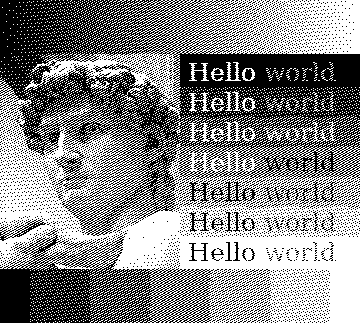
Looks pretty good! It looks a bit like a dither, but with fewer artifacts. Definitely a "sharper" look than blue noise, but in places like the transitions between the text boxes you can definitely see a bit more artifacts (almost looks like the boxes have a staggered edge).
Thanks for bringing this to my attention!
Ooh, I haven't actually! I'll need to implement and test this for sure. Looking at the results though it does remind me of a dither (https://pippin.gimp.org/a_dither/), which I guess makes sense since they are created in a broadly similar way.