 alt Hacker News
Whenever split keyboards come up, ulnar deviation is mentioned, and non-split keyboard users are depicted to be using the keyboard like this (image from the post):
https://www.justinmklam.com/posts/2026/02/beginners-guide-sp...
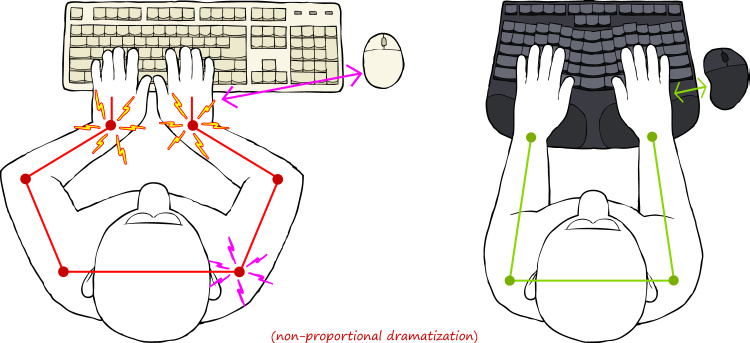
I don't know if it's just me, but I don't use the keyboard like that. I know the illustration is said to be exaggerated, but still. There is no need to squeeze your hands in front of the keyboard. Just naturally bring your hands in front of chest, the same as when you are reading a book or writing notes with a pen. No twisted wrists. No ulnar deviation. The idea that you can't do something with your hand in front of the center of your chest without hurting the wrists seem like a strange supposition.
Admittedly, I've never looked at a significant number of people typing on a non-split keyboard, so I don't have the data to refute the need of this invention. I just feel like the natural posture already doesn't have the problem of ulnar deviation.
Replies
I’ve been a consistent split keyboard user for a quarter century now. My current daily driver is a Redox, which uses a columnar layout. I got into them when I first started having problems with tendinitis. I feel like they help, but I’m not sure what the science says about it.
Anyway, I’ve always hated that diagram because it’s so obviously hyperbolic. I also use standard keyboards on a daily basis, and while there are some posture differences, the bending to make hands perpendicular to the keyboard just does not happen. Comfortably placing your fingers on the home row requires angling your hands a bit because the fingers are all different lengths. Are there some posture differences? Sure. But from what I’ve seen they’re really quite minor.
What I would guess makes more of a difference is tenting. Which is admittedly only possible with a split design. But also, not all split keyboards do tent.
Also, and this one might be specific to my particular problem, moving keys the thumb strikes to a position that it can reach with less stretching has helped a lot. (I suspect that the space bar in particular might have been the source of most of my woes.) And that’s another variable that’s highly correlated with - but still not the same as - the keyboard being split.
Sometimes you are forced into the ulnar deviation for other reasons.
For example:
- I have long arms (6'3" fingertip to fingertip)
- I have bad vision (20/40 is best I can get even with glasses)
- B/c of the above I like to have the monitor close to me (or I sit closer to the monitor)
- For a long time (5 years) I worked on a trading floor with a desk with very limited depth so my wrists were often turned inward
So I ended up getting a split keyboard (Kinesis Freestyle) so I could spread my hands farther apart so I didn't get the ulnar deviation.
All typing guides I’ve seen recommend keeping fingers on home row. If you do that you end up pretty close to what that drawing shows.
Homerow centric posture is imho the main cause of keyboard related pain.
Unfortunately, many Qwerty typing guides group keys in left-leaning columns [1], requiring many to twist their left wrist. And this is why I hope the angle mod [2] from the Colemak community gets more mainstream recognition: instead of learning to twist your wrist, just shift the keys to let them adapt to you. This "un-kinks" the layout, allowing your left wrist to remain perfectly straight while your arm approaches the keyboard at a natural, relaxed angle like the person in the right side of the drawing.
Yes. I'd swear that people that unfortunately fall into RSI also fall into a negative cycle of moving less and favoring a static position at all levels - fingers, wrists, shoulders.
Our bodies love movement and it's often a recipe for solving all sorts of issues.
What gets me the most is that all the "correct typing posture" images seem to indicate that it's best to keep the keyboard low, close to you, elbows bent around 90 degrees. In this position the palms are naturally positioned so thumbs are pointing up, and you need to force the palms to be level with the keyboard (that's pronation/supination if I recall correctly). That's just madness to me, I can't last more than few minutes in that position.
Maybe it's related to finger length. On the home row, my index finger is somewhat stretched and my little finger is bent.
I think a shockingly high number of people really do type Z with their little finger, X with their ring finger, and C with their middle finger. It's the only way I can explain how they end up that way in columnar layouts so often.
This is madness to me. That would wreak havoc on a wrist. Type Z with the ring finger, X with the middle finger, and C and V with the index finger, just like you type M with your right index finger.
I cannot for the life of me understand the claims by ortholinear fans that fingers travel in a straight line as they expand. Mine don't. My fingers are much farther apart when I extend them than when I pull them in, and I think I have a fairly ordinary set of hands.