 alt Hacker News
Getting Creative with Perlin Noise Fields
Comments
Author here. I wrote this many years ago (2017?) while exploring techniques to create art that I could put up on my walls :-) If you enjoyed this article there are more similar ones linked on the main page: https://sighack.com/
Curl Noise[1] is also cool. I've used it to create some gas giant planets for video games [2] though I used opensimplex noise [3] rather than perlin as the base noise, but either will work.
[1] https://www.cs.ubc.ca/~rbridson/docs/bridson-siggraph2007-cu... [2] https://github.com/smcameron/gaseous-giganticus [3] https://en.wikipedia.org/wiki/OpenSimplex_noise
If you dig Perlin noise fields, the next stop is fBM (Fractional Brownian Motion). Inigo Quilez has a good article about it - https://iquilezles.org/articles/fbm/
Nice examples, I think I landed on that page quite a while ago. I love Processing and Perlin noise. One thing I enjoyed was using Perlin noise values to compute a "region" on the canvas and making the behavior of a particle depend on which region it was in. Examples:
https://020406.org/processing/PerlinNoiseBounds1.png

https://020406.org/processing/PerlinNoiseBounds2.png
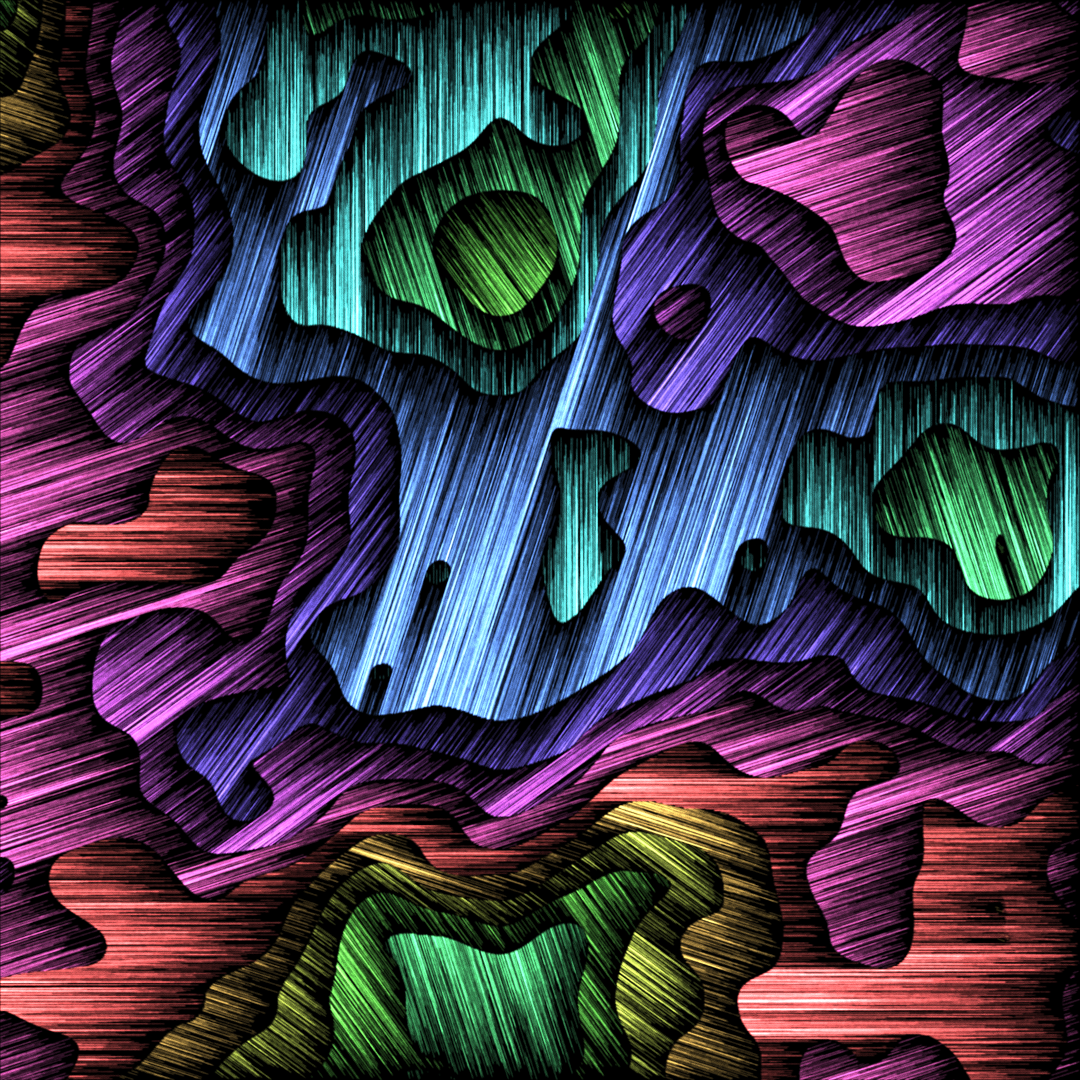
https://020406.org/processing/PerlinNoiseBounds3.png

The Processing code I wrote to make them is here: https://github.com/Brian-Fearn/Processing/blob/main/PerlinNo...
Generative artist here: the beautiful thing about this exploration is that these techniques can be applied to ANY vector field, whether they originate in random noise or global simulations.
The reason these add so much visual interest to a simple noise function is that each pixels color now relies on many more of the random values. Generative art blossoms with this extra computational effort.
Reminds me of this writeup that I read recently about using a different noise function (not Perlin) to emulate terrain erosion: https://blog.runevision.com/2026/03/fast-and-gorgeous-erosio...
It turns out that adding noise to gradients is a really useful thing to do - so many new effects can be created with just a few additional parameters. Sadly, CSS and Canvas API gradients (linear, radial, conic) are very basic implementations (and SVG is not much more advanced).
Recently I did some work to add software gradient enhancements to my canvas library. Because these run on the CPU rather than GPU they're computationally intense, but still worth the effort just to see what can be done with different spreads (pad, repeat, reflect, transparent) and noise engine operations inserted while calculating stuff like gradient color selection, and pixel positioning.
Linear gradient demo test - https://scrawl-v8.rikweb.org.uk/demo/canvas-003.html
Really nice exploration, and their other posts are interesting too!
We used Perlin noise for demos of our Golang/BubbleTea terminal Glyph heatmap widget and then later with our Picture widget.
Live WASM demos of the Golang terminal programs:
https://nimblemarkets.github.io/ntcharts/demos/heatmap-perli...
https://nimblemarkets.github.io/ntcharts/demos/heatpicture-p... Press 't' to switch between glyph/image modes
My old work using perlin noise https://a.tulv.in/noise-planets.html
I learned a lot about perlin noise when generating virtual worlds for Wurm Unlimited fascinating stuff and very satisfying when you get results you’re looking for.
If you have played Minecraft, you have a pretty good idea what kind of things Perlin Noise can generate. Maybe not the structures but definitely the terrain is generated by Perlin noise. (At least it was in the 1.4.7 days when I was in the code.)
Great write up! I also dove in to this topic a while ago over at https://damoonrashidi.me/articles/flow-field-methods, but putting the live processing sketches in was a very nice touch! Good job, and nice outputs!
Very beautiful.
I am a complete newbie, so I might be asking about something obvious -- does anyone know how some of these would relate to plotting random Polya vector fields ?
For example, one can take a sum of complex rational functions of the form
f_i(z) = r_i / (z - p_i)
One needs to plot the conjugate of sum_i f_i(z).
EDIT: so many lovely pages pointed to in the comments ! Let me convey collective thanks to all, rather than clutter this page with individual thanks.
@ttctciyf you are marked dead. Not sure why.
Couldn't help myself and asked Google Studio to one shot this: https://perlin-noise-fields-explorer-560691554368.us-east1.r...
This is awesome
some beautiful effects and good ideas. My favs are iterations 8, 20, 25
One of the cool things to do with Perlin noise is to build a kinda predictable random number generator. Good for games.
This is super nice article. Will revisit this one more time and try that out as well. In the age of AI slop, it is such a pleasure to read actual people blogs about what they do and are passionate about. Thank you this one!
[flagged]
[dead]
[dead]
If you're into exploring this sort of thing yourself, I can extremely highly recommend Daniel Shiffman's Nature of Code[1]. It's among my top-5 recommended books about computing in general, let alone for algorithmic art.
[1]: https://natureofcode.com/