 alt Hacker News
Mixing Visual and Textual Code
Comments
SikuliX was a UI automation tool from over a decade ago with an IDE that looked similar to their screenshots: https://avleonov.com/wp-content/uploads/2017/02/script_windo...
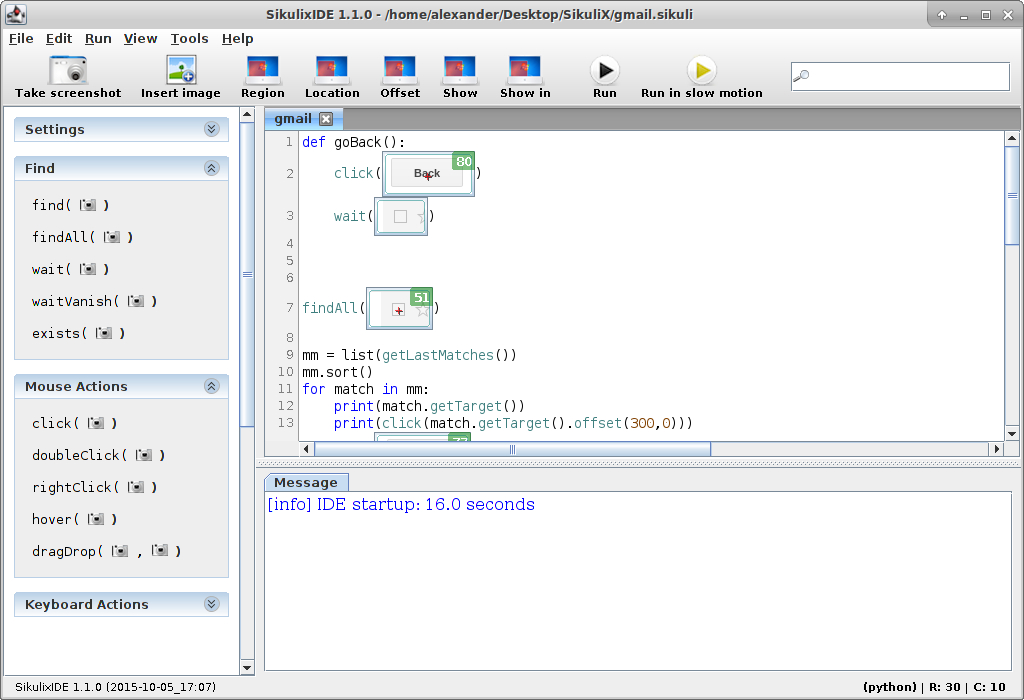
The language was just python and the IDE swapped out certain functions' arguments with the image and targets within the image that the code referred to. It also had a bunch of built-in functionality that let you manipulate the images and targets (the little red crosses in that screenshot) directly within the IDE instead of having to edit the underlying python code.
Looks like it has a successor called Oculix but I know nothing about that.
Every to often a project will come along which reminds me of the visions which Hermann Hesse's _The Glass Bead Game_ (originally published as _Magister Ludi_) inspired in me --- this looks to be the latest.
Looking forward to reading the paper and hope that it is widely read/discussed, and that it influences projects/developers such as: https://www.inkandswitch.com/
I'd dearly love to see a 3D CAD program which used this methodology.
I work daily in TouchDesigner and am constantly wrestling with the integration of its node and Python scripting contexts. In particular order of operations, delegation of responsibility, and store of state are very unsolved areas when expressing intent across both domains.
Visual languages often fail when it comes to concurrent development where the state of the art is textual diff and merge. The IBM Rational suite attempted visual model diff/merge but I recall it being unworkable in practice.
Modern collaborative visual tools like Miro sidestep the concurrent development problem by being live multiplayer and by essentially having no version management at all.
Most visual BPM tools that I'm aware of try to mix flowchart style programming with e.g. Javascript on activity nodes, but they fail provide any developer-time syntax checking or completion. They also tend to serialise to XML which is unworkable in practice for diff/merge of the visual logic.
In a previous job we developed an in-house flowchart based language that embedded Javascript. We put the effort into writing a first-class Eclipse plugin that had syntax checking and completion across all graphical and Javascript constructs. It even had interactive debugging that interleaved graphical and textual single-stepping. We never solved the diff/merge problem in a satisfactory way.
Hm...the screenshots don't really sell it;
Maybe the authors should just vibe code a cljs port and put it in a browser?
And showcase some program written in this language that sells it better?
So cool! Love that Clojure(Script) is the language of choice here. Seeing a graphical tile nestled in a function call blew my mind for a hot minute, there.
https://bsky.app/profile/watwa.re/post/3lizpdz34522g
I'm working on a similar idea, it's been a while since I published about it but open to input and collabs!
We have the complete AST in almost every IDE. Why are we not learning to render abstracted code and systems from that??
Oh dear. I think they may fall over in surprise when they realize that this technology become commercially viable while they were busy writing this academic paper...
A very long time ago I wrote an Eclipse plug in that would read from source comments an ascii diagram describing the state/transition flow of a java class object, and generate/update the necessary state fields and transition methods.
It was pretty cool in principle but nearly unworkable in practice, purely because maintaining an ascii diagram in a text editor for anything more than "Hello world" is a massive PITA.
The simple text editor has a lot to answer for when it comes to how we think about programming, in a Sapir-Whorf kind of way. It's a shame there has been no cast iron standard for mixing live text and visuals. Our industry might look very different.