 alt Hacker News
Homomorphically encrypted CIFAR-10 inference in 200ms
Comments
They have a bit more info on their announcement blog post[0]
> Belfort today released the "so far" CIFAR demo, an encrypted implementation of ResNet-20, a popular model for image classification. It outperforms recent SOTA by 3x with a total latency of less than 200ms
Not many details on how they've done this, so I'm a bit skeptical. Fast HE is a holy grail.
> Belfort's image classification is built on top of its upcoming GPU library, Cyclops. It comes with several optimizations that make Cyclops extremely fast on Encrypted AI workloads.
Looks like a lead up to an upcoming library release
I think they only trained on dogs with floppy ears, because it is very confident the German Shepherd is a cat.
Big if true! One of the caveats here is that the file size seems to balloon 341 times.
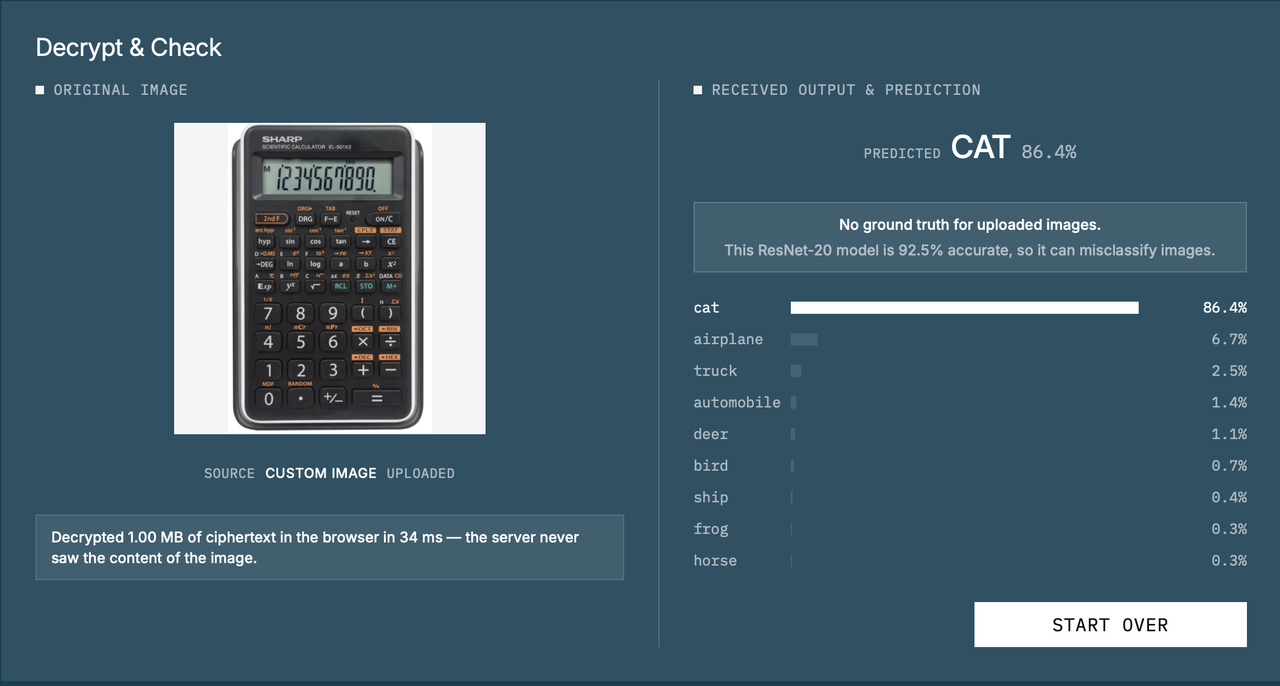
It's pretty confident this calculator is a cat.
https://i.postimg.cc/90WGjk8t/results.png
What's the use case for this?
Kudos to the KULeuven alumni, but I am curious if the US finances research on homomorphic encryption still /s
Looked at the network logs and the JS, did some testing, there's a caveat here. For an encryption demo you might expect your secrets to be generated locally, they do the compute on something they can't read, you compare their results to your original plaintext; (imo at least) the point would be that it isn't physically possible for them to cheat.
Here, you literally download client_secret.bin from their server, so they have control over the keys and evaluators. So two things. First, the per user key flow would be several minutes for per user keys, the evaluator bundle would be in the 100s MB to GB realm. Second, there's no way for us to tell the difference between them really doing FHE or decrypting with the key. To be clear, not evidence it's fake, just not total proof it's real. Really hope it's real, been a field I've been following for awhile.