 alt Hacker News
They already grow, they are already harvested, and this process uses discarded parts of the harvest. It is putting in use what we already had but had no use for.
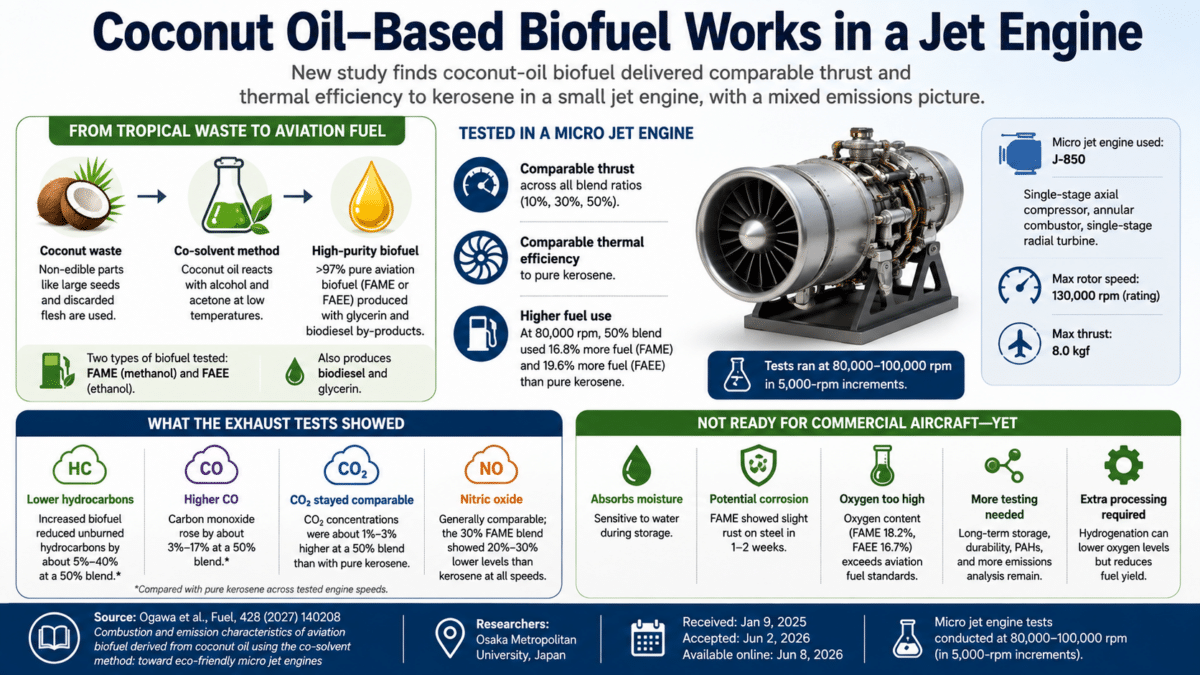
Edit: the article speaks about possibilities that open. It also clearly notices that the a number of problems are unsolved. The infographic is direct: https://studyfinds.com/wp-content/uploads/2026/08/Coconut-Bi...
Note that if some product available in limited amount, say "coconut oil", becomes an asset to improve any context, say "aviation", it does not follow that one should maximize that amount psychotically without a cost-risk-benefit. You can just exploit the available yield through planning.
Replies
I presume that the market for coconut oil is far smaller than for jet fuel, so this solution can't scale without wreaking havoc on the environment. These sort of clever uses for exisiting byproducts only work when the market for the main product is much bigger than for the byproduct (e.g. down is a byproduct of duck/goose meat, leather is a byproduct of beef).
Apparently (I’m relying on facts from Claude here), aviation uses about 100 billion gallons of oil a year and coconuts yield about 250 gal/acre, so assuming you can approximately replace them 1:1, you would need to plant about 400 million acres under coconut plantation, an area the size of Mexico.
Edit: you don’t have to plant all of Mexico, every percent of fuel you replace is the equivalent of a percentage of a country under a single crop, displacing what would have been there before (presumably some kind of food).
Are there really discarded parts? Usually when people talk about discarded parts, what they really mean is those not used in the first process. The article says "parts of the crop that would otherwise go to waste", but just a quick glance seems to show that there are other products that uses those parts of the crop, like biodegradable packaging and animal feed.
Turning it into fuel and burning it would compete with the other uses for those 30%.
To what scale though? Doubtful it's going to be enough for a replacement. Just as GP stated, the corn grown for ethanol is nothing more than an additive and it is quite easy to find fuel without it. It's a boondoggle and not any where close to being a fossil fuel replacement
That infographic says it uses 16-20% more fuel per unit of thrust. That's a significant amount more weight for an aircraft to carry, but because carrying extra fuel also burns fuel, extra fuel use would compound exponentially. This would probably mean significantly more than 20% extra fuel would be required for long-haul flights.