 alt Hacker News
I've been doing a bunch of stuff with using a PUT[1] to simulate an IF (Integrate and Fire) neuron[2]. Right now I'm experimenting with variations of pulse-width and frequency of the input spike train, seeing how that affects when the "neuron" fires. In a future step I'll add a resistor to bleed off some of the charge from the timing capacitor, to make it more of a "Leaky Integrate and Fire" neuron.
And then ... well, we'll see. I'm also reading a lot of books and stuff on neuroscience, neuromorphic computing[3], analog computing, etc. I don't have some "grand unified theory" or anything, just playing around in this space.
There's a lot more I could say about this, but I'll save that for a blog post or something. That said, if anybody wants to see some pictures and read some write-ups of some of this stuff, add me on LinkedIn[4] and you'll see some of that stuff in my activity there.
EDIT:
What the heck, here's a picture for anybody who's interested.
https://fogbeam.com/images/scope_20260913_202613.png
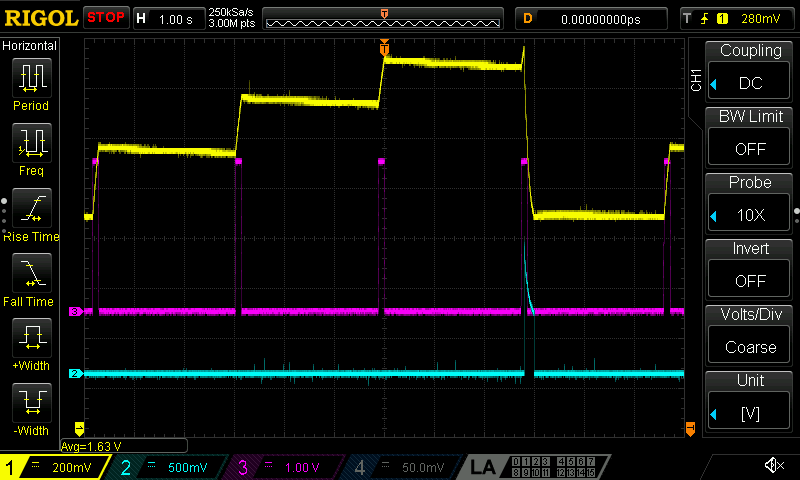
The magenta trace is the "spike train" which is output from a Rigol DG4162 Function Generator. The yellow trace is the voltage at the anode of the PUT, which simulates the "action potential" of the neuron membrane. And the cyan trace is the cathode of the PUT, which simulates the output of the neuron. What we see here are several input pulses hitting, with each bumping the action potential up a little, until it finally hits a threshold and then "fires" and resets. Lather rinse repeat.
[1]: https://en.wikipedia.org/wiki/Programmable_unijunction_trans...
[2]: https://neuronaldynamics.epfl.ch/online/Ch1.S3.html