 alt Hacker News
PenGPT: A Generative Transformer for Handwriting and Sketches
Comments
Author here! Given that I only trained these on an 8xH100 it's not exactly the most spectacular illustration of the Bitter Lesson. All I can say is that historically I always wanted to impress people with better model architectures or training techniques.
This time I just put all my energy into data. Agentic workflows + good open weight vision models + cheap multimodal AI APIs make data quality filtering / caption generation really smooth
I took the liberty of adding the models to penelope.ink. So now when the model is transcribing, I get contextual doodles generated from past notes.
Looks a little bit like this: https://i.ibb.co/21Z4mWV7/AI-doodles.png (coffee-cup, "emai deliverabiliti was ..." etc.) Very fun! Thanks OP!
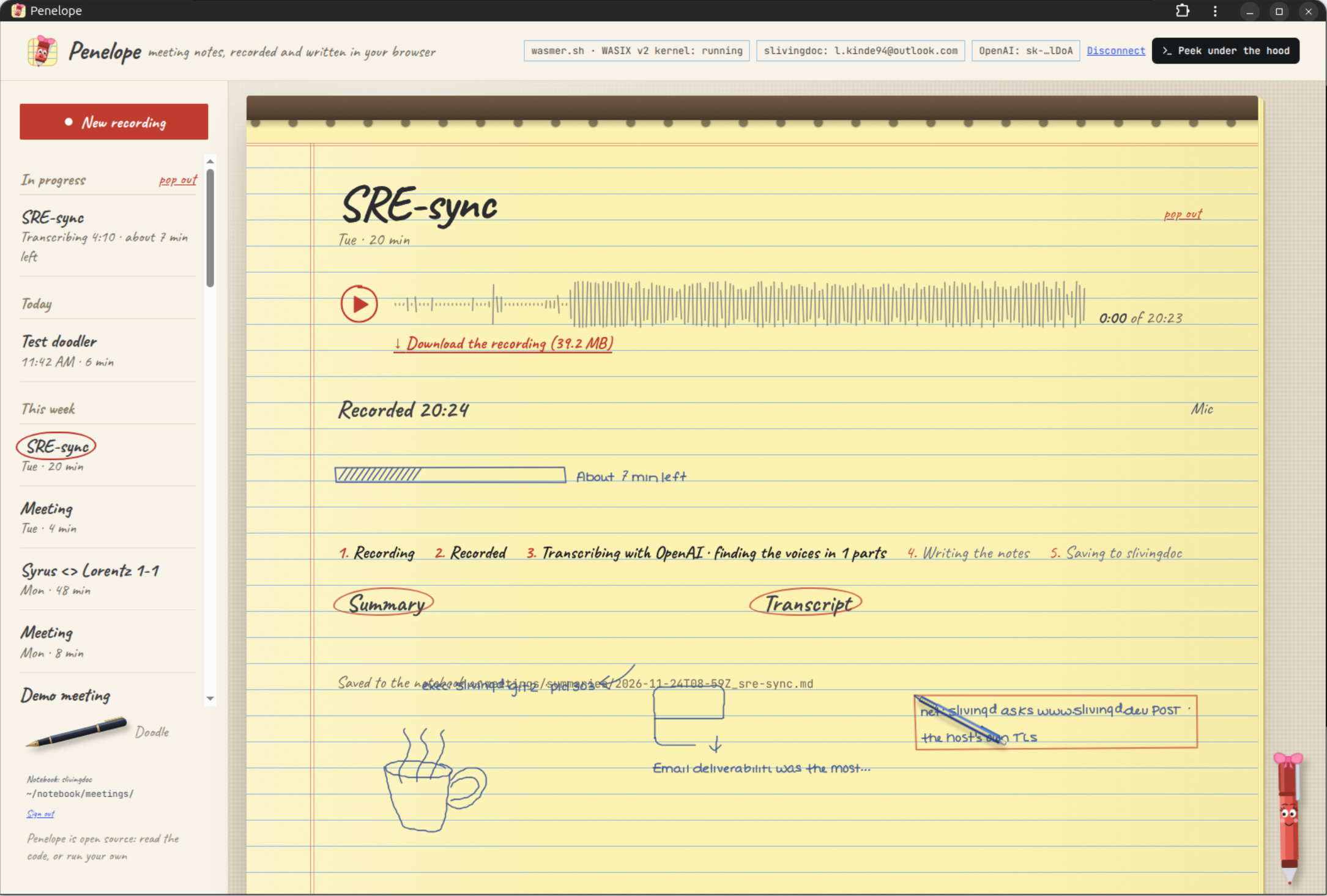
I'd love a good local model that does the reverse - takes my scribbles and transcribes into legible text. Preferrably maintaining the intent.
Doing "Detailed field guide drawing of a lion's mane mushroom" and getting a horrifying mix of a lion and a mushroom was rather entertaining.
Looks very creative! It feels like there are lots of uses for transformers to be explored beyond text and images. Are we at the point yet where the average programmer Joe can play around with this stuff and make a small task-specific model with some python libraries? Or do you need to understand all the math? Still need to read the white paper so maybe it’s covered.
Sam is a ripper. Lovely blog post. Good to see his name float back up.
When I was a senior in college working on my eng thesis [1], some of his earlier posts (Scribe: Generating Realistic Handwriting with TensorFlow [2]) were helpful and inspiring to read.
[1]: https://johnlarkin1.github.io/pdfs/Handwriting-Synthesis-E90...
It's cool, and on the face of it looks impressive (there's a lot of diversity in styles) but I noticed a "tell" that once you see it, is really obvious. Lots of straight lines (Is, Ls, Fs, As, Ms, etc) have wobbles in them that look artificial. There's something about lines that this didn't capture correctly (or oversampled from someone with wobbly lines).
Wow. Don't forget to try the Draw mode, artificial doodles!
It can do penguins, pelicans (kinda), and bicycles, but pelican on bike makes it generate bizarre semi-abstract art. Looks like it doesn't know how to combine things together.
That's so cool, and a lot of fun to play with.
The project is impressive, but I've really wondered why so many of these types of blogs are Claudish. Just running it through another SOTA model or two, then reading yourself can clean things up. Compared to the work of the project itself, this seems comparatively painless, but is so often neglected.
How would this made posible to write in other languages? Would it have to re-trained on real hadwritten papers on other languages or it could adopt to other languages glyph shapes?
This is amazing. I've been building a presentation model and will definitely be digging deep into this. I feel like graphical real-time presentation is an essential part of learning and transferring knowledge and it's completely missed by existing models.
i really love this. i think there's something fun and refreshing in seeing human writing and drawing for some reason
Really neat. Also makes it easy to add your own handwriting and drawings.
I don't know how I should feel about the fact that pushing the "neat/loose" cursor all the way to "loose" still outputs something prettier than my own handwriting.
Interesting, it doesn’t handle Spanish well at all (try Spanish “teach me”: enséñame), that said would be interesting to contribute to other languages.
With the phrase "minimum aluminium" it's encouraging to see the model's output descend into illegibility in the same way my own handwriting does.
Very cool! Not so good at drawing a pelican riding a bicycle
When I first heard the name. I thought it's for penteration testing.
Seems like for some input it stops prematurely.
For example, `!2/23\4/5.4;3;5l=3asfa913k391aslkf9a'a;s.":>"}+-=;.a`
Oh this is great! I’ve been working an app to teach handwriting with Rokid glasses. I’ll give it a shot
this is so cool! the drawing feature is so fun for some reason, although I wish it was just ever so marginally better or smarter. its right there.
"Stroke tokens" stood out to me
Very nice congratulations. Long road since the first MNIST dataset. This project is useful for me since I am building an OCR model to properly parse hand written posologies. I already have all the data I needed, I could use this to generate synthetic data to strenghten my model.
It bothers me how it doesn't know the proper strokes for cursive characters.
Neat!
very impressive
[flagged]
[flagged]
I wonder if this model would have performed better if it wasn’t trained on awful 2000’s handwriting.
The most interesting part to me is this mention of the Bitter Lesson [1]
"The results are interesting and the project was a pleasure to work on. And yet there was no clever architectural idea behind it. About 80% of my effort went into building the biggest, cleanest datasets possible and doing lots of quality control on them."
I spend way too much time on trying to out-clever existing solutions, when a clean application of known approaches would serve best.
[1] http://www.incompleteideas.net/IncIdeas/BitterLesson.html