 alt Hacker News
British Columbia is permanently adopting daylight time
Comments
These discussions are always very annoying. People tend to state their preferences without mentioning their latitude, their longitude, or their current time zone.
Anyway, here are my preferences: GB should switch to UTC+0 all year. UTC+1 all year was tried (1968-1971) and was very unpopular in Scotland. School hours are roughly 09:00 till 15:00 and they only get about 6 hours of sunlight in winter up north so local noon has to be at around 12:00. Also, for political reasons relating to Northern Ireland, it is very helpful for GB and Ireland to have the same time. So UTC+0 it is.
Seasonal changes in school hours is a theoretical possibility, but parents of schoolchildren have a hard enough time as it is and lots of other things are linked to school hours. It would be much easier for everyone else to make seasonal changes to their timetables, like just get up an hour earlier if you want to. Nobody's stopping you.
Why now? From the Govt of BC press release: "The Interpretation Amendment Act, which is the legal framework that enables the Province to adopt permanent DST, became law in 2019. At the time, government chose not to bring it into force in order to co-ordinate timing with neighbouring U.S. states in the same time zone.
Recent actions from the U.S. have shifted how B.C. approaches decisions that merit alignment, including on time zones. Making this change now reflects the current preferences and needs of British Columbians, and helps ensure the province is well-positioned to thrive, even when circumstances across the border evolve."
I would have preferred permanent standard time to permanent daylight time. But I accept I'm in the minority, and even permanent daylight time is far superior to changing clocks twice a year.
Almost nowhere do you see the sun directly overhead at noon, even during Standard Time. The differences can be quite stark: https://24timezones.com/cms-static/images/uploads/solartimev...
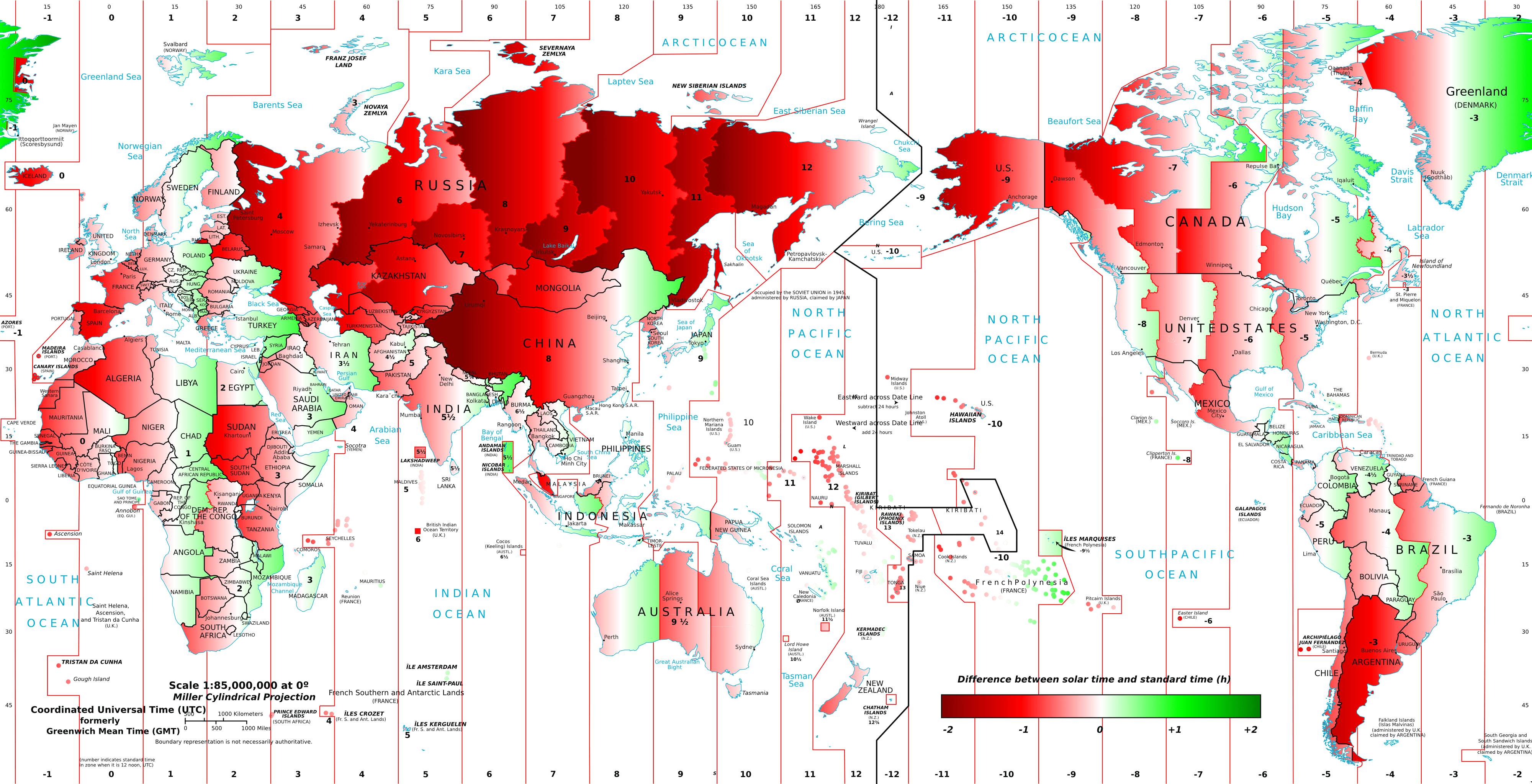
BC (and PST) is actually quite reasonable in this regard, with Vancouver and LA being fairly close to "on the money." Contrast that with China and Russia, where clock time can be 2h+ off from solar time.
As a further note, this is one reason it's miserable to be in Boston/Maine during the winter if you're an SAD sufferer: sunset times of 4pm or sooner feel like "insult to injury."
Ultimately the arguments between whether one should pick daylight or standard times are a red herring.
The benefits of one over the other usually balance out and in either case are insignificant compared to the problems caused by changing time zones twice a year.
Changing time zones is directly linked with all sorts of health issues, deaths, car crashes, etc.
Chances are it will get repealed because it isn't standard time.
Examples of failed permanent daylight switches:
- USA 70s
- Russia 2010s
- UK 70s
The only examples of failed switches to permanent standard time are Egypt and Jordan.
There are 12 prominent examples with permanent standard time, including most of Mexico, Argentina, Russia, and parts of Australia.
Only the Yukon, Turkey, Jordan, Morocco, and Syria are on permanent daylight time.
DST is popular because people associate it with summer, so it is chosen as the permanent time. Then the population experiences reality of no sunshine when they get up in the winter and hate it.
The European Parliament voted to end clock changes in 2019 [1] but it got stuck and nothing happened. Meanwhile, BC just goes ahead and does it. I suppose one can still dream... :)
[1] https://www.timeanddate.com/news/time/end-clock-changes-euro...
Permanent standard time would have made more sense to me, but I get it – humans can't possibly influence fundamental natural forces such as school starting times, TV schedules, museum opening hours etc.
This will never not feel insane to me, it's just because no one wants to say "move classes and work an hour later on [x date]". Somehow changing noon away from noon is a better answer.
"Pacific time" is going to be so confusing though. Should have just called it Yukon Standard Time, since that's already a thing, at least informally. Cause that would not be confusing at all...
Good to see this is getting more common!
Changing the time every year cause a lot of accidents involving wildlife. Wild animals learn human activity patterns and avoid the roads during our active hours. When we shift the time we start they get caught off guard and a lot of accidents happen. It takes roughly 2 weeks of adjustment apparently.
Ignoring the fact itself, doing this in a single province and not the whole country is the really wild thing for me (as a European). I have opinions about DST but having it different per German state sounds much more horrible than anything we have now, no matter how complicated the rules are.
Everyone else is throwing in there 2¢, so here's my pet proposal.
Here's the undeniable fact: everyone (ok, almost everyone, but it's a rounding error) hates the switchover in spring, when you have to get up an hour earlier. Conversely, everyone (or a rough approximation) likes the switchover in the fall, when we get to sleep in an extra hour. So why don't we just get rid of the switchover in the spring and get rid of the one in the fall?
I went looking for a visualization tool to help get a sense of what this change means experientially. Found this:
My dream world is everyone using 24 hour clocks set to UTC
I fully support removing DST (as a parent at least, it's a PITA twice a year).
However, clocks should show noon correctly, as best as they can within your chosen timezone. Also, I really like long evenings in the summer to get outdoors and go biking or hiking. It follows that we should abolish DST, stick to the correct time, and move regular school and business hours back one hour.
> Residents will have eight months to prepare for Nov. 1, 2026, when the clocks would have been turned back one hour, but will now remain the same.
That's an odd read. Residents have eight months to prepare for an event already known to be nonexistent: a non-happening.
In germany the terms are Sommerzeit (summer time) and Winterzeit (winter time). Of course everybody would chose the former as summer sound better than winter but the latter is "better" as it corresponds more to "wake up when there is light" which is favorable to health, performance etc.
It's worth noting that in China, where the whole country is on a single timezone (which is roughly solar time in the eastern part, but far from it in the western part), places in the west simply have a different notion of time.
I am so jealous. I hope the entire West Coast can follow this example.
I suggest installing Sun Dial on youres smartwatch. Especially when daytime is 4 hours, it somewhat aleviates the "eternal darkness" brain fuzz. I try to be awake on those few hours, and do not care about those other dials.
There is Sun Dial right there on Zepp Watchmaker on "editable components". From 9 to 15 seems to best amplitude as it reflects the sun's movement on the skies.
A few years ago I was against changing the time but now I tend to even suggest a full two hour change! In the developed northern hemisphere the summer/winter daylight difference is huge (about 2 hours in the morning and 2 in the night) with a short time of equal length. Maximizing sunlight exposure while the people are outside is vital, mainly for psychological purposes. That means let the light begin at about 7-8 all year long and let summer afternoon extend as much as possible. No kid leaves home before 8 and the 6-in-the-morning drivers will pay attention all year long and not only during the winter. But all types of people will enjoy the long summer afternoons.
What is daylight time - daylight savings? If so, I'm all for this. Dark in the mornings, more sun in the evenings, win-win.
Not all of British Columbia can make the change. BC's northeast and much of the Columbia-Kootenays are presently on Mountain time, which means that the Province of Alberta holds the choice of when/whether their own and those BC areas go to a permanent time. Then AB would have to sync with Saskatchewan along their borders, but SK is already on a permanent time zone system. Decisions, decisions.
I think regular time is always the correct option.
If you want to move work start time. Regulate that. Schools, government institutions and public transport can all be directed. The rest will likely follow on recommendation. See for period of time and allow those that want to re-adjust again for their needs.
It would be great to see Europe adopt it as well. Changing clocks twice a year feels outdated and more disruptive than beneficial.
If there's a single section of the entire world where daylight savings makes the most, it's above and below the 45th parallel. This means the earliest sunrise is 9am in the winter what a horrible idea just to give people a little bit more sunlight when they'd still be out at work anyways.
Compromise solution: In the spring, just lose the hour during the workday at 3pm instead of in the middle of the night. Designate that missing hour a holiday so employees still have to get paid for it. All the complaints about switching back and forth would go away.
The tzdata database is a modern miracle.
Here's the IANA time zone mailing list thread where this is being discussed:
https://lists.iana.org/hyperkitty/list/[email protected]/thread/66...
Bad timing on BC's part. They just tagged release 2026a today.
And we're stoked!
Fellow Vancouverites: what ... fall back ... strategy are you planning on executing, as an alternative? :)
Instead of starting work at 8 AM we just moved the sun?
Buying stocks in curtain manufacturers and cow sunscreen retailers.
This is the best possible choice. I hope everywhere follows suit.
How exactly do I fix the backend after this? Will a newer version of php or nodeJS have the correct handling of these timezone changes? I’ve been wondering about this for a while but can’t find an answer when googling.
lucky mfers
Finally a win for BC, they really really needed it.
Ahhhhh I've been waiting for Oregon to do this for years. The idea that driving north in winter would make the sun set an hour later is maddening.
I'll genuinely miss it getting dark at 4PM. Winter won't be the same.
what does "daylight time" mean?
is it summer time or winter time?
Lame. I'm convinced that people think DST actually creates more daylight. If people want more daylight, leave work earlier. Work less. Most of your jobs don't matter anyway. For people who have jobs that do matter, like teachers, nurses etc. the choice between 0 or +1 hardly makes a difference. Should have just gone with 0.
About fucking time! The EU has been edging us all since 2019 on ending daylight savings, and it seems to have stalled yet again...
tangentially related, Dr. Andrew Huberman shared a video in which he asserts that exposing one's eyes to sunlight very soon after waking is "good for your brain" (essentially): https://www.youtube.com/watch?v=h2aWYjSA1Jc
https://grok.com/share/c2hhcmQtMi1jb3B5_f52a6bb5-dc0d-4a3a-8...
Multiple peer-reviewed studies and analyses indicate an increase in traffic accidents—particularly fatal ones—following the spring transition to DST. This is often attributed to acute sleep deprivation (losing one hour of sleep), circadian rhythm disruption, and altered light conditions during peak commuting hours, which can impair alertness, reaction times, and visibility. Key findings include:
A large-scale U.S. study analyzing over 732,000 fatal motor vehicle accidents from 1996 to 2017 (published in Current Biology, 2020) reported a consistent 6% increase in fatal crash risk during the workweek immediately following the spring DST transition, equating to approximately 28 additional deaths annually in the U.S. The effect was more pronounced in western regions of time zones and persisted into afternoon hours despite longer evening daylight. Other research has documented short-term spikes, such as increases of 16% on the first day and 12% on the second day after the spring change in some analyses, or broader elevations in fatal crashes linked to the "DST effect." Systematic reviews and meta-analyses confirm short-term elevations in collision risk post-spring transition in many (though not all) contexts, with some evidence of higher fatal accident rates in the U.S. specifically.
The fall transition back to Standard Time shows more mixed or opposite patterns: some studies report small increases in certain crash types (e.g., due to darker evening commutes increasing pedestrian or deer-vehicle collisions), while others note decreases in vehicle-occupant fatalities or no net increase overall. A 2017 systematic review of road traffic collision risk found inconsistent short-term effects across studies (some showing increases, decreases, or no change), but long-term analyses often suggested a net safety benefit from DST periods due to evening light. Recent Insurance Institute for Highway Safety (IIHS) research (covering 2010–2019 U.S. data) indicated that spring DST increases fatal motor-vehicle occupant crashes (+12% in the following five weeks) but decreases fatal pedestrian/bicyclist crashes (−24%), resulting in a near-neutral net effect on total fatal crashes (slight increase in occupant deaths offset by fewer pedestrian/cyclist deaths). In summary, your memory is correct in that empirical data—particularly from U.S.-based studies—support an increase in traffic accident frequency (especially fatal crashes) associated with Daylight Saving Time variations, most reliably in the immediate aftermath of the spring transition due to sleep loss and misalignment. However, effects are not uniform across all studies, regions, or crash types, and some research highlights trade-offs (e.g., benefits to pedestrians from evening light). Debates continue regarding permanent DST, permanent Standard Time, or abolition of changes altogether, with organizations like the American Academy of Sleep Medicine favoring permanent Standard Time to minimize disruptions.
Most people agree that changing the clock twice a year is silly, for obvious reasons. Still, there's a small minority that thinks that the existing system is good, for obvious reasons. Among those who want to abolish time zone change, there's roughly 50/50 split between those who prefer permanent summer time for obvious reasons, and those who prefer permanent winter time for obvious reasons. There are a few more exotic ideas floating around - many of which are obviously better than any of mainstream ones, but they unfortunately have a low chance of being adopted.
The end result is probably going to be more and more fracture on local level, as smal units of administration adopt their favorite solutions. This is obviously bad for doing business between units of administration, and obviously good for circadian rhythms of the people living within given unit. One thing obviously has more importance than the other.
FInally!
I'm in BC. The astro-nerd in me would have preferred to see permanent Standard Time instead of a permanent +1 offset. Instinctively, I think morning light is important to our biology for a daily reset and the solar cue of "high noon" is also a real thing. I'm sure I've read that sleep health experts have historically supported a change to permanent Standard Time, not DST.
I respect there are economic arguments for permanent DST. But I question the road safety stat I hear with announcements like this. Kids walking, biking, and being driven to school in mornings in darkness ... that's also what permanent DST gives us.
Oh well, I am in the minority it seems. So R.I.P. "high noon" ... I'll never see you again here. And, yes, I understand that depending on where one is within a time zone, a true "high noon" is only in theory. But it's a nice ideal. :-)