 alt Hacker News
Do coconuts grow particularly efficiently?
Edit: The US created biofuel subsidies a few years ago and it’s led to poor use of land with questionable climate impact. It’s effectively become a wealth transfer to support poor rural American communities, which isn’t necessarily a bad thing but there’re probably more effective ways to do that intentionally.
Replies
They already grow, they are already harvested, and this process uses discarded parts of the harvest. It is putting in use what we already had but had no use for.
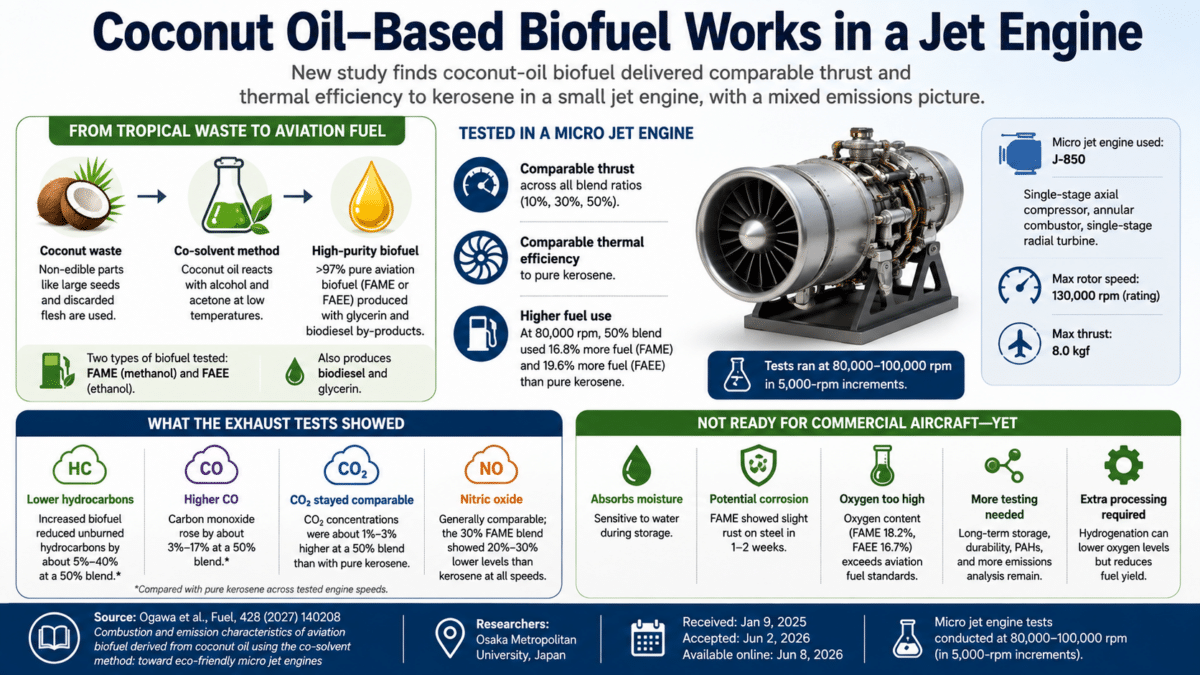
Edit: the article speaks about possibilities that open. It also clearly notices that the a number of problems are unsolved. The infographic is direct: https://studyfinds.com/wp-content/uploads/2026/08/Coconut-Bi...
Note that if some product available in limited amount, say "coconut oil", becomes an asset to improve any context, say "aviation", it does not follow that one should maximize that amount psychotically without a cost-risk-benefit. You can just exploit the available yield through planning.
> it’s led to poor use of land with questionable climate impact.
In the short term, yes, because they were unnecessarily using carbon energy to grow the fuel.
But if we want to de-fossilise society in the long run, we need solutions for flying and long distance travel. Electric flying seems infeasible at the moment, and people are looking for suitable bio-fuels to make flying carbon neutral. Afaik the maximum planes were allowed to handle up to now, was a 50-50 mix kerosene-biofuel. [0]
Coconuts could be a breakthrough!
Is it not a bad thing to encourage poor people to continue doing the thing that has apparently made them poor?
It's also very not true that farmers are poor in the US (median household income about 30% greater than general population). This mindset is like a century old.
All subsidies are wealth transfers. That's the whole point- to incentivize something that wouldn't otherwise happen at a scale the government deems to be of benefit or necessary.
Biofuels are part of the all-in-one story of renewable energy, especially the transition phase of reducing carbon emissions before we can get to full electrification.
The question of whether or not they are effective in doing so- and whether or not the money for those subsidies would better benefit society elsewhere- is the very same one that skeptics of solar and wind hammer on.
I would much rather see those subsidies go to farmers growing human consumer food, and sending the excess to bioreactors to produce fertilizer and/or methane for power generation. Cheaper groceries make it easier for people to eat more whole foods, after all. Just last week, I found napa cabbage at $3/lb- meaning one head would have been $24. Fresh broccoli and other good veg are also expensive.
The reduction of harm from reduced CO2 by bio-jet-fuel would pale in significance compared to, say, subsidies in regenerative farming practices, or even simply healthy crops.
Middle of the road, comparable to Sunflower oil. But they want to utilize waste products and a low energy conversion process.
They literally grow on trees
Same rural communities raise pitchforks upon mention of any other demographic receiving wealth transfers.
"It’s effectively become a wealth transfer to support poor rural American communities"
I'm skeptical that rural community are the primary beneficiaries. Seems more likely that it's benefiting people who own the patents/companies.
Are the people against bioengineered produce also be against us working towards super efficient coconuts or some other plant we designed to fill the same role?
Just through this out again, biofuels are dumb. Per acre a solar farm produces 30 times the energy per year as corn without most of the environmental concerns that growing corn has.
You don't have pesticide or fertilizer runoff from solar farms. You don't plow the soil resulting in soil loss.
Biofuels, dumb.
> a wealth transfer to support poor rural American communities
My immediate reaction to this is: it's probably a wewlth transfer to the few landlords owning the land and probably charging higher rent, not to the communities.
Of course I haven't analysed the data. If I am wrong, hopefully someone will feel compelled to correct me.