 alt Hacker News
Ti-84 Evo
Comments
About 25 years ago my parents got me a Ti84 as a surprise for Christmas and they hid it in the attic so I couldn't find it in the meantime. A few months went by and a couple days before Christmas, when it was time to wrap the presents they couldn't find it anymore. My dad went out and got a Casio something as a late minute replacement, and that was the calculator I used in high school and I never knew about this story. Then last year I found a Ti84 in my parents attic...
From here: https://www.cemetech.net/news/2026/4/1062/_/ti-84-evo-calcul...
> 3x Processing Power - Matching one of the speculated options, the calculator appears to use an ARM Cortex CPU, finally retiring the z80 and ez80 family of CPUs that were used in three decades of TI-83 and TI-84 Plus graphing calculators. It's running at 156MHz, compared to the 48MHz of the older calculators. It appears likely that in an unexpected break from over 30 years of TI's operating system codebase, the OS has been re-implemented with new features natively on the ARM CPU rather than using an ez80 emulator to run an updated form of the TI-84 Plus CE operating system.
It looks like TI is finally moving away from the Z80. This must have been a pretty big engineering effort on TI's part. Like the article says, up to this point all of TI's low-end graphing calculators have been Z80 based and use the same system software that has a lineage dating back to the early 1990s. They were previously so wedded to the Z80 that when they introduced Python programming to their calculators, they did so by adding an ARM microcontroller that runs MicroPython, while the main eZ80 CPU acts as a serial terminal.
Summary of the comments in here:
* I used the programming functionality of the calculator to get around the rules
* I didn't care much for the math, but my TI calculator was my first programming experience and it's what got me to love programming
My experience is similar. We were allowed to use our TI-85s in class, but we had to go up to the teacher before the test and show him that we were running a factory reset, to prove we had nothing programmed in it to cheat.
My buddy and I had made a two player blackjack game and didn't want to have to retype it after every test. So instead we made a program that mimicked the factory reset process. You would run the program before walking up tot he front.
The only indication something was different was the three little dots in the corner indicating a programming was running, but we just covered that with our thumbs.
Ironically we never used it to cheat, only to not erase our game that we programmed!
We had to buy those calculators for highschool and it was a waste of money, felt like somebody must be paying somebody off to have thousands of students buy a device that they will certainly never have to use (and is of little educational value).
Show me a highschool math problem you can't do on a $12 Casio scientific like the classic FX-300MS https://www.usaofficemachines.com/csofx300ms-fx-300ms-scient...
There's even knockoffs of it for $1: https://www.aliexpress.us/item/3256809744184708.html
I picked one up when the 99 cent store was shutting down. It works fine.
Look what you can get for $20: https://www.casio.com/intl/scientific-calculators/product.FX...
TI is like the Intuit of the education world. I want to love them but this is ridiculous - a N4120 celeron laptop is the same price as this new calculator - it might be a garbage laptop but it's doing a heck of a lot more for your $160 than this calculator is.
I find it interesting that TI still seems to use custom ASIC chips for their calculators.
Any MCU out of their portfolio should be fully capable of driving the display, reading the keyboard. And the math should be lightweight for even the smallest processors nowadays.
Does it still use Zilog eZ80 (Z80-family, 24-bit) as the main CPU?
Ti really needs to stop with the artificial product differentiation. There's no reason 15 years after the Nspire CX CAS came out that everyone of their calculators can't do CAS.
Nostalgia aside... these things aren't really that great and are overpriced for what they are. TI sustains itself on basically extorting high schools and colleges to use that.. because most of the teachers just used these.
I'm not sure such a device really improved any understanding of the underlying mathematics that I was taught. In fact, in more advanced mathematics these machines can't even keep up.
I'm surprised to see "Approved for Exams" featured so prominently, as handheld calculators for lots of standardized exams are being phased out.
All of the exams listed are either already offered in a computerized format or in a transition phase, with the PSAT, SAT, APs, and ACT all already offering Desmos in their testing apps.
I love handheld calculators, but, especially in a time-sensitive environment, it's hard to beat a large screen and full keyboard.
In high school I had the TI-89 Titanium. Like everyone here, I got into programming it using some USB adapter I could attach to my iMac G5 and the TI Connect app[0].
One day, vexed by something, I vented my frustration by composing a profanity-laced rant into the Feedback window of the TI Connect app. (I don't recall the proximate cause, but I remember complaining that the product itself, which is still $110 today, is a total ripoff.)
I was certainly surprised when the (sole?) TI Connect developer responded by e-mail taking umbrage at my complaints.
0: https://education.ti.com/en/products/computer-software/ti-co...
> Built to be a reliable learning tool, not a distraction
15 year old me in math class programming my loaned TI-82: CHALLENGE ACCEPTED!
> Simplified keypad
> The keypad layout removes clutter and makes commands and shortcuts easier to see, so you can work faster with fewer steps.
I don't see it. I compared a screenshot of one of these to a older T-84, and it looks like they have same number of buttons, and the buttons are just as cluttered (except the EVO has secondary labels on the keycaps instead of the case).
That's a good thing, since one of the best things about calculators is they typically have a ton of buttons for quick access to a lot of functions.
The comments on this are fascinating. Although, I was waiting for someone to chime in with "HP is better cuz RPN."
2 dinners out for a family of four would cover the cost of this calculator. If my kid's school required this for math, I wouldn't bat an eye at purchasing one.
I needed a Ti-83 for school in 1996-1998. If you couldn't afford one, the school would loan you one for the semester. Band instruments were the same way.
Those who have used various classic HP calculators in the past may be interested in this:
https://www.swissmicros.com/products
These are clones of various older calculators.
I was introduced to the 83 Plus and it was simply the most mindblowing device at the time. We were given a sheet to share with our parents on why it was an important device to own/borrow. Me and several friends would trade apps through the TI-Link cable, and we would play games, write software for it and there was even a popularity rank in school about whose program was installed on more calculators.
For a lot of people it introduced them to TI-Basic which was quite capable, and for others you could get into Assembly which allowed for more powerful applications. There were 2 parts of the memory, BASIC programs were in regular memory that could be easily erased, and another part which was Flash Apps.
I later upgraded to the 89 which had a better CPU, screen resolution and processing power and it was phenomenal in helping me understand every single math class, including EE/EECS. It made me sad to see them banned in exams, because having a 83+/89/any calculator was in no way helpful in any of the exams I took, but it was more of a "control the students" thing in college. The Math department determined that because they couldn't prove that people were not using the internet/portable PC's in their calculators, that they could not guarantee the fairness of it all.
Weird argument to make knowing that a 20 year old student was engineering a full internet capable PC into a calculator at the time would have been the envy of the world (and every engineering program).
This all depends on the quality of education and not simply handing out problems that require rote memorization of the methods to solve an equation and instead derive or figure out the equation yourself after understanding the problem after which you're free to use the calculator to "plug and chug".
I loved my TI-84+ SE and wish I still had it (had all sorts of custom programs on it but it got lost or stolen before I finished high school).
That said, I find it really hard to believe that they can't provide better specs and feature set for the cost. User-available memory of 3.5MB is incredibly low, especially with Python support. These could be really cool handheld computers if TI put more effort into their devices that already have a massive install base.
Currently, most of their popularity in my experience is "lock in" effect from teachers who are familiar with TI calculators and lab / curriculum materials that are specifically built around teaching through TI calculators. At this rate they're charging a lot and resting on their near monopoly status in education, which I'm sure is very profitable for TI.
There used to be a great app called WabbitEmu that emulated these devices on Android. I think they got a cease and desist but it was pretty neat to have back in the day
What calculators are you guys using that aren't in academia anymore and don't need the "exam approved" limitations?
Or are we all just using software on our computers now.
That would be sad.
(I've had a Casio fx-991EX on my desk for a few years, that replaced a broken Casio fx-991ES. Though designed for academia, its operation is burned into my brain at this point.)
To bad it is still made for pupils and not engineers. I tried using it for computer science and math and it lost to a Casio
There's the NumWorks which is very similar for a more reasonable price, that also run Python
I used to doodle and make pixel art on my TI 84+ in high school. I'd spend entire classes just clicking left, right, up, down, and enter to move and toggle individual pixels with a simple program I'd written. https://timstr.website/artwork/ti84plus.html
It's a beautiful device so much that hacker inside me wants to poke into what CPU they have and design a similar one in Verilog myself then put it on FPGA with similar display and it's driver then a 3D printed case and keys too.
I'll take my father's HP 49g to my grave. but if TI wanted to flirt with me, all it would take is a setting to enable Reverse Polish Notation. (I did check the features, and no mention).
Why do you need an online calculator subscription? I can kind of get why you want a physical calculator, especially for a school environment, but why would you want a calculator online when you can just use... the rest of the web?
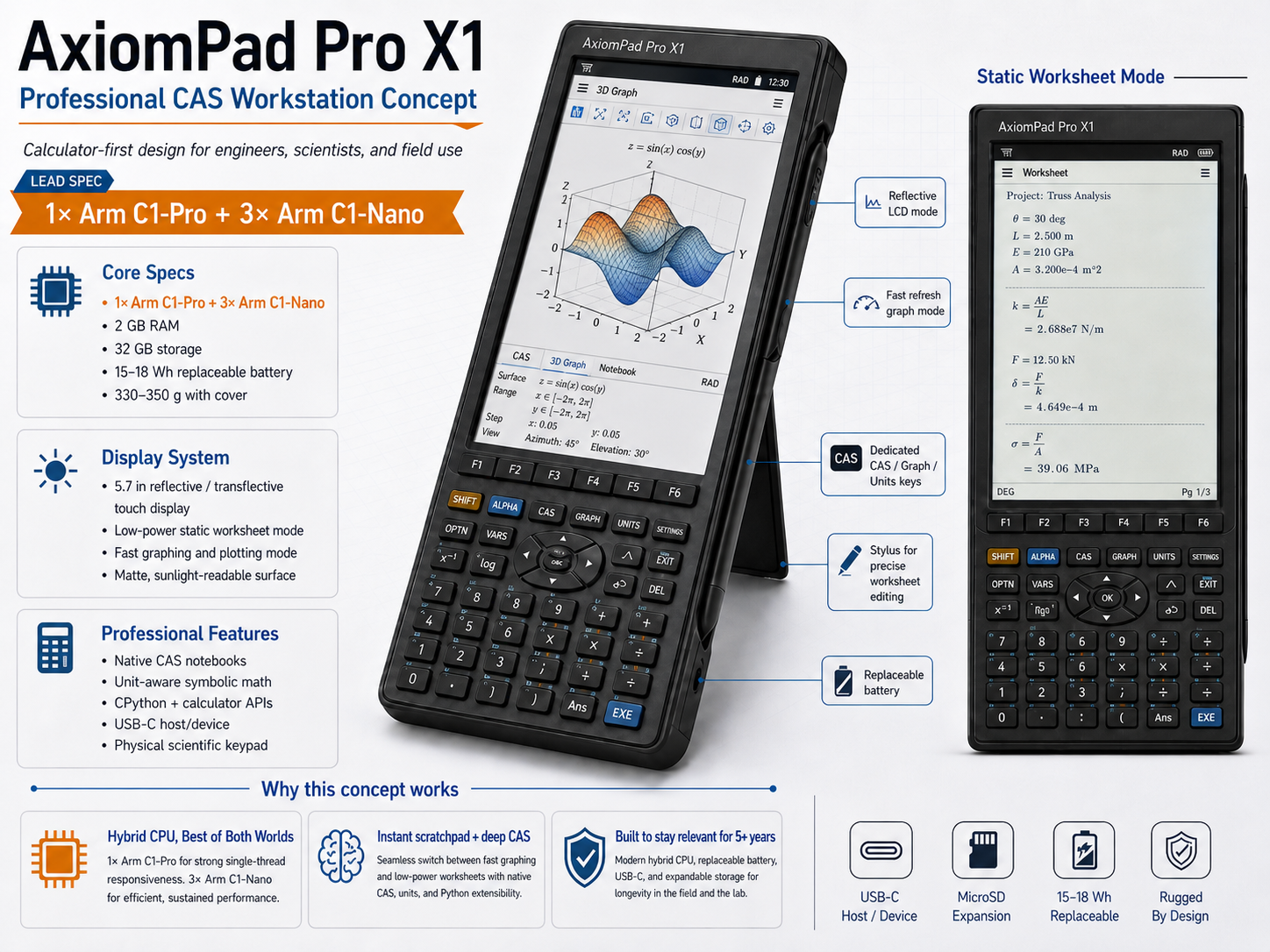
This has me pining for a future professional class CAS 3d graphing calculator.
I'm thinking something that could be a major upgrade in spirit to the long-in-the-tooth (released a decade ago) Casio FX-CG500.
Could use the soon to be released ARM C-1 Nano and Pro cores in an SoC with stacked 2GB LPDDR4, USB-C charging to a large battery, high-res transflective LCD...
Mockup "AxiomPad Pro X1": https://enia.cc/out/axiompad-cas-mock.png
Shout out to https://ticalc.org/ - the design is pretty much unchanged.
I didn't have a calculator until my senior year of highschool. But since we weren't alliwed to use them in tests, I didn't feel like I was missing anything.
As an engineering student at CMU, I had an HP 15c like everyone else. A few years back when I found out they are coveted, I sold mine on ebay. I have an emulator on my phone.
I assume that calculators will continue to evolve and that my grandchildren will have a Propædeutic Enchiridion.
My ti-82/83 got me into programming because I hated math so much that I taught myself to code an app that would help walk me through how to do various problems. I got in trouble but it was worth it.
Also, drug wars, x wing vs tie fighter, and all sorts of other awesome games were definitely the fun thing to do with these.
I still have my TI-83 plus. It's been with me for 25 years now! I've always kept it on my desk, despite the fact that I engraved 'KoЯn' on cover when I was 13 or 14.
Simply the best: https://www.hp.com/us-en/calculators.html
As someone who built a custom serial cable (not my idea, greetz to the original designer) to load assembly programs on TI-85s for all my friends, the “approved for exams” shit is so funny
I learned to program on a TI-83 and later bought a TI-84+ with the cable that allowed me to transfer my apps and games between my device and other students devices. I have fond memories of hand typing into a TI-83 BASIC for hours using code I found online at the local library - games like Drug Wars and other similar choose this or that console based games. I would later get a USB cable that allowed me to download apps and games onto my device. Good times. Decades later and I'm still programming.
And those goddamn displays still have the pixel density of a Tamagotchi.
$160 at Amazon: https://www.amazon.com/Texas-Instruments-TI84-TI-Calculator/...
Not as bad as I would've expected. Also, apparently it includes a very simple Python environment? https://education.ti.com/en/product-resources/eguides/eguide...
the best calculator is of course a RPN calculator, preferably a HP 48GX, but HP Prime also suffices. Swissmicros DM42N is a good second :-)
156MHz and 3,5MB user memory... Why do I feel like that is a joke these days.. I think some ESP32s are faster and have more memory, but not sure if they are fully comparable...
Interesting that this doesn't seem to include a computer algebra system like the Nspire CAS. Wonder if it's a testing environment compliance thing?
Bring back the HP-10c. RPN with "scientific calculator" label. Pure and simple, and approved for testing that forbids any programmable devices.
EDIT: oops, conflated with HP-35, from a decade earlier. 10c was programmable. HP-35 was not.
HP48GX rules, HP Prime is a solid second. SwissMicros DM42N is a solid third.
Wasting time making games on my TI84 in the back of middle school geometry taught me how to program.
How is the battery life? Rechargeable sure is nice, but the older models lasted forever on 4 AAAs (at least my TI-83). That's one aspect that would justify the low processing power for today's standards for portable computing devices.
Loved it in university and still use it on my phone:
I personally think this is stupid (e.g., the new interface for selecting functions). The interface on original 84 was better. I still have mine from 15 years ago. I still use it.
Do these graphing calculators still use Derive (tm)? pity, there is no pc version anymore
"Built to be a reliable learning tool, not a distraction"
They clearly haven't met a classroom of high school kids. Then again... I didn't have access to the internet in my pocket when I was in high school so....
I have no idea how on earth a scientific calculator costs almost as much as a cheap android phone. Do they use oled and snapdragon soc these days? Back in my school days a 20$ Casio seems more than enough.
You will have to pry my TI-89 from my cold dead hands. I wish they still made it
There is something impressive about a product line that can remain culturally relevant for this long, even if part of that durability comes from a very protected niche.
My TI-85 story. While I was in prison, around 1996 or 1997, I found out a friend had a TI-85 calculator. I realized it was programmable, so I borrowed it over the weekend and wrote a program to track his stock portfolio. It was the first time I had programmed anything in 2 or 3 years.
Then I learned that the US Bureau of Prisons had a rule against any calculator (or device) that was "programmable". So I programmed the TI-85 so its startup screen read, "TI-85 NON-PROGRAMMABLE CALCULATOR". Problem solved.